
De-dollarization: Does Trump Want a Weaker US Dollar?

Donald, if you’re reading this—and I have to assume you are, since you’ve demonstrated an almost supernatural ability to find anyone who’s ever said anything about you, ever, including that one guy in Des Moines who tweeted something mildly critical at 3 AM and then had to change his phone number—I want to start by saying I’m sorry.
I have, over the years, said some things. Unkind things. Things that may have implied you were somehow personally responsible for the decline of Western civilization, the extinction of nuance, and the fact that I can no longer have a conversation with my uncle at Thanksgiving without someone bringing up the deep state. That was unfair of me. The deep state thing was already happening. You merely... accelerated the discourse.
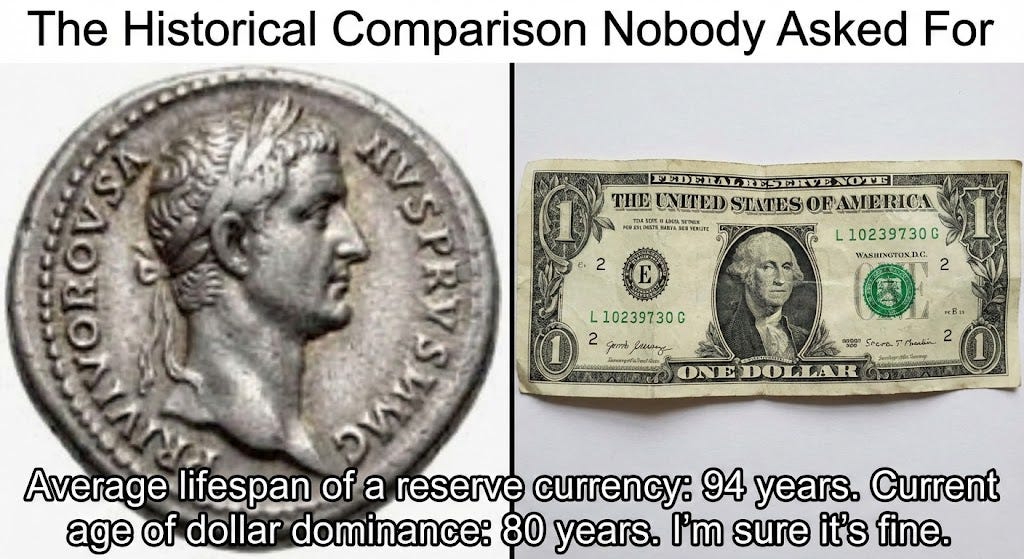
Look, I know things haven’t been easy. The media hates you. Half of the country hates you. The other half loves you in a way that I suspect you sometimes find a little overwhelming, like when a golden retriever is really, really glad to see you and you’re wearing nice pants. And now here you are, in your second act, trying to Make America Great Again (Again), and people like me keep writing pieces with titles like “De-dollarization: Does Trump Want a Weaker US Dollar?” as if we’re somehow qualified to render judgment on matters of global macroeconomic strategy.
(I am not qualified. I want to be very clear about this. My understanding of currency markets is roughly equivalent to my understanding of cricket: I know it exists, I know my family cares about it deeply, and I know that when I pretend to understand what’s happening I am fooling precisely no one.)
But here’s the thing, Donald. Here’s the thing that’s been keeping me up at night, or at least keeping me mildly distracted during the day while I’m supposed to be doing other things. You said something in July—”It doesn’t sound good, but you make a hell of a lot more money with a weaker dollar... than you do with a strong dollar”—and when the dollar hit a four-year low this week and someone asked you about it, you said you thought it was “doing great.”
And I thought: Does he know? Does he know?
A Brief Tangent on What “Knowing” Even Means
See, there’s this thing that happens in markets where the distinction between “wanting something to happen” and “causing something to happen” and “being fine with something that happened because of something else entirely” gets very blurry very fast. It’s like when you leave a party early and then later you hear the cops showed up, and you’re not sure if you’re relieved or disappointed that you missed the drama. You didn’t want the cops to show up. But also you didn’t not want the cops to show up. You just left.
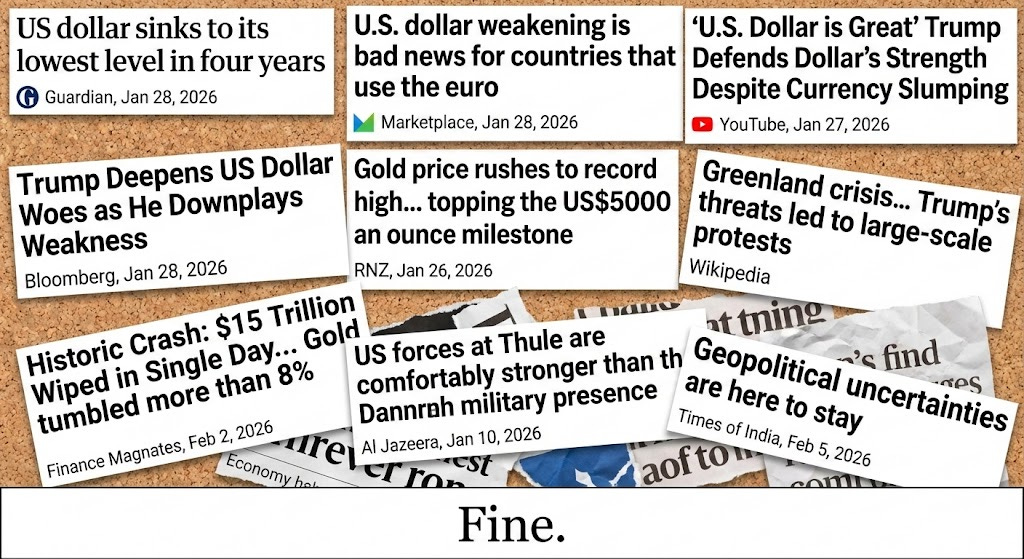
The dollar dropped 10% last year. A lot of that happened after Liberation Day—and I’m still not entirely sure how we landed on “Liberation Day” as the branding for a tariff announcement, but I suppose “Tariff Day” lacks a certain revolutionary panache, and “The Day We Made Everyone Very Nervous About The Global Trading System Day” is admittedly a mouthful. The point is: the dollar fell. And it’s fallen further since.
Is this good? Is this bad? Is this what you wanted?
I genuinely don’t know, Donald. And I suspect—and I mean this respectfully—that you might not entirely know either.
The Part Where I Pretend to Understand What’s Happening
Okay, so here’s the situation as I understand it, which is to say here’s the situation as various analysts and researchers understand it, filtered through my profoundly limited ability to retain information that doesn’t directly relate to obscure historical trivia or the precise moment when any given TV show jumped the shark.
The US dollar is still, technically, dominant. When people trade currencies—like, 88% of all traded foreign exchange volume—they’re trading dollars. When companies invoice each other for international trade, about 40-50% of it is in dollars. When emerging markets issue foreign currency debt, 70% of that is dollar-denominated. The greenback, as the financial journalists insist on calling it (because apparently we’re all living in a 1940s noir film), remains the king.
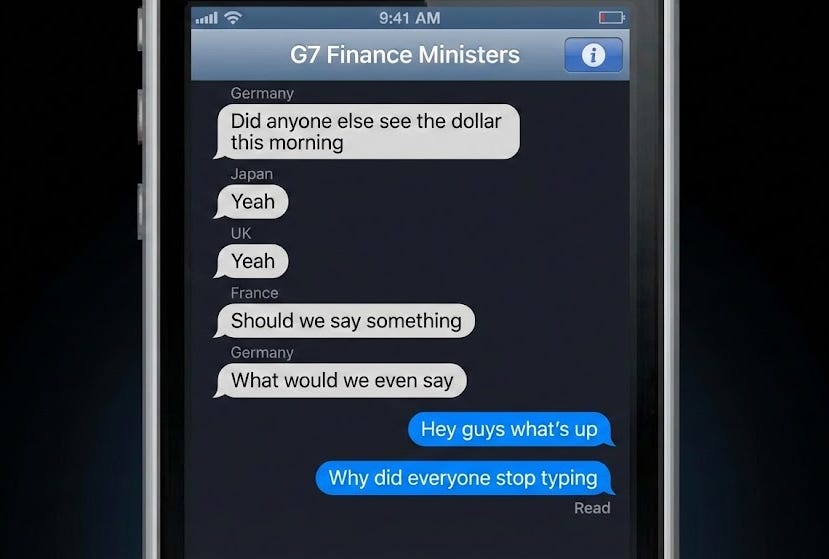
But.
There’s always a but.
Central bank reserves? The dollar’s share has slipped to a two-decade low. Still around 60%, but trending down. Foreign ownership of US Treasuries? Was above 50% during the financial crisis, now it’s around 30%. And commodity markets—this is where it gets interesting—a large and growing proportion of energy is being priced in non-dollar contracts. Russia’s selling oil in rubles and yuan. India’s buying Russian coal and paying in yuan, sometimes without any Chinese intermediary involved at all, which is like paying for your neighbor’s lawn care in Canadian tire money except the neighbor is Bangladesh and the lawn care is a 1.4 gigawatt nuclear power plant.
Also, everyone’s buying gold. Like, a lot of gold. China, Russia, Turkey—these countries have been accumulating gold like it’s going out of style, except the thing about gold is that it never goes out of style because it’s gold and people have been obsessed with it for roughly six thousand years. Some analysts think gold prices could hit $4,000 an ounce by mid-2026, which sounds fake but apparently is a real prediction made by real people with real jobs at real financial institutions.
The Part Where I Address You Directly Again
Donald, here’s what I think is happening, and I want to be clear that “what I think is happening” should be weighted appropriately, which is to say not very much.
You want a weaker dollar because it makes American exports more competitive. This is not a crazy thing to want. This is, in fact, a coherent economic position held by serious people. A weaker dollar means American goods are cheaper for foreign buyers, which means more demand for American goods, which means more American jobs. This is Economics 101 stuff. I took Economics 101. I got a B+. (I would have gotten an A but I fundamentally misunderstood the concept of opportunity cost on the midterm, which in retrospect is kind of ironic given how much of my life since then has been defined by poor opportunity cost calculations.)
The problem, as one analyst put it, is that there’s a difference between the dollar weakening for the “right reasons” versus the “wrong reasons.” If the dollar weakens because America is humming along and the rest of the world is finally catching up and everyone’s doing great, that’s fine. That’s healthy. That’s the dollar losing weight because it started going to the gym, not because it has a wasting disease.
But if the dollar weakens because global investors look at American policy and think, “What in the fresh hell is going on over there?”—if it weakens because of what another analyst called “the haphazard nature of policy in this administration”—then that’s... less good. That’s the market rendering a verdict, and the verdict is: we are concerned.
A Brief Digression on Greenland
I feel like we need to talk about Greenland.
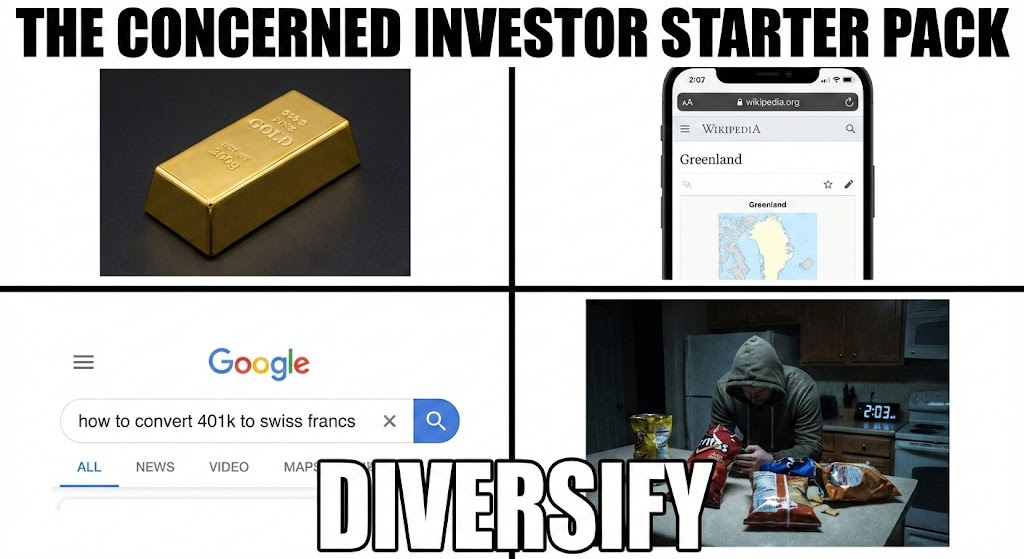
I don’t really understand the Greenland thing. I mean, I understand it in the sense that I’ve read the words and I know what the words mean individually, but when I put them together in my head they form a kind of conceptual shape that my brain refuses to fully accept. We want to buy Greenland? We’re applying tariff pressure related to Greenland? We’re having escalating tensions with Europe over Greenland?
Anyway, the dollar fell partly because of Greenland. Or at least, the Greenland situation contributed to a general sense of “we don’t know what’s going to happen next,” which is not a sentiment that global currency markets respond to with enthusiasm. Markets like predictability. Markets like knowing what the rules are. Markets do not like waking up in the morning and discovering that today’s geopolitical crisis involves a large Arctic island with a population smaller than most mid-sized American cities.
(Greenland has about 56,000 people. That’s fewer people than live in Pocatello, Idaho. I have nothing against Pocatello, Idaho. I’m sure it’s lovely. But we are not, as far as I know, trying to buy Pocatello, Idaho, from anyone, mostly because we already own it.)
The Part Where I Try to Be Somewhat Fair
Look, Donald, I know I’m being glib. I’m always being glib. It’s a defense mechanism. The world is very complicated and I am very confused and if I don’t make jokes about it I will have to actually sit with my confusion, and that sounds exhausting.
But here’s what I actually think, underneath all the glibness:
You’re not wrong that the dollar’s dominance isn’t necessarily, inherently, good for America in all circumstances. There’s something called the “Triffin dilemma”—and I’m just going to throw that out there without really explaining it because if I’m being honest I only sort of understand it myself—but the basic idea is that being the world’s reserve currency comes with costs as well as benefits. It means your currency is always in demand, which sounds nice but also means it’s always a bit overvalued, which hurts your exporters, which means you run persistent trade deficits, which means you’re shipping jobs overseas, which is a thing you have been very vocally against for a very long time.
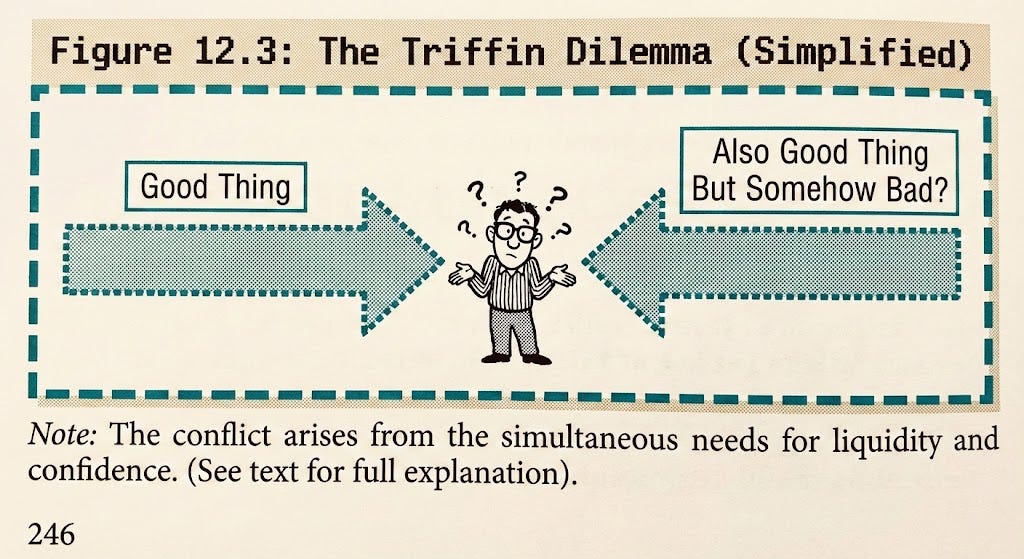
So when you say you want a weaker dollar, that’s not crazy. That’s a position. It’s a position that breaks with decades of official US policy—the “strong dollar policy” has been gospel since Robert Rubin—but it’s a position that has a logic to it.
The question, Donald, is whether you can get there without burning down the house.
The House
The “house” in this metaphor is the complex web of financial arrangements that have made the United States the center of the global economic system for the better part of a century. The fact that everyone uses dollars means everyone needs dollars, which means everyone is willing to lend us dollars at relatively low interest rates, which means we can run deficits that would bankrupt any other country without breaking a sweat. It’s a good deal. It’s arguably the best deal in the history of international finance.
De-dollarization—real de-dollarization, not the “the dollar’s share slipped two percentage points” kind but the “nobody wants your funny money anymore” kind—would be bad. Really bad. Every one percentage point decline in foreign holdings of Treasuries relative to GDP could push yields up by more than 33 basis points, according to some estimates. If Japan—which holds over a trillion dollars of our debt—decided to start selling in earnest, we would feel it. The government’s borrowing costs would spike. The deficit would balloon further. Things would get ugly.
Is this happening? Not yet. Not really. Analysts keep saying we’re not at a “full ‘sell America’ narrative.” The stock market is still near record highs. Treasury yields haven’t blown out. But the dollar keeps falling, and gold keeps rising, and more and more countries keep figuring out ways to trade with each other without involving us at all, and at some point all these small changes add up to a big change.
I think you’re betting you can get the benefits of a weaker dollar without the costs. I think you’re betting that America is too big and too important and too deeply embedded in the global system for anyone to really walk away.
You might be right. You’ve been right before, about things that everyone said you were wrong about. I try to remember that, even when I’m being sarcastic and superior. Which is most of the time. But I try.
The Conclusion, Except I’m Not Going to Call It That Because My Boss Explicitly Told Me Not to Use Phrases Like “The Conclusion”
Donald, I don’t know what’s going to happen. Nobody knows what’s going to happen. The people who claim to know what’s going to happen are either lying or deluded or trying to sell you something, possibly a newsletter.
What I know is this: the dollar fell to a four-year low last week and you said it was “doing great.” And maybe it is. Maybe this is all part of a plan, and the plan is working, and in two years we’ll all be standing around marveling at how well it worked out.
Or maybe the plan is “do things and see what happens,” which is, to be fair, not the worst plan in the world. It’s how I approach most of my life decisions. It’s how I ended up living where I live and working where I work and marrying who I married. You can get surprisingly far on “do things and see what happens.”
But currency markets are not my marriage. They are not forgiving. They do not give you the benefit of the doubt because you’ve been together a long time and you always remember to take out the trash. They render verdicts, and the verdicts are final, and by the time you realize you’ve lost the market’s confidence it’s usually too late to get it back.
So I guess what I’m saying is: be careful, Donald. Not because I’m rooting against you—I genuinely don’t know what I’m rooting for at this point—but because the thing you’re playing with is bigger than you, bigger than any of us, and it has a tendency to do things that no one expected.
The dollar is still doing the heavy lifting for now. But even load-bearing structures fail eventually, if you lean on them hard enough.
Anyway, that’s 2,400 words on international monetary policy by a guy who had to Google “Triffin dilemma” three times while writing this. Subscribe for more.
Jay Patel